CyberSmart Technologies has rebranded.
Welcome to Rollcage Defence.

Apostille and Analogs
Apostille
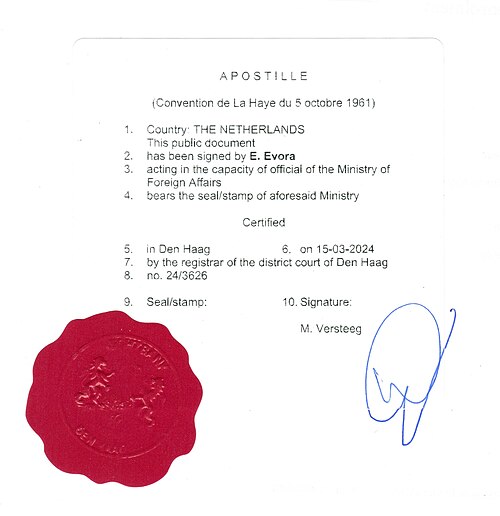
It is easy to forget that we in IT didn’t invent the modern world. I recently learned about the ‘Apostille’ when doing an international background check. Apostille is a system of cross-country recognition of public documents.
The system was invented in The Hague in 1961 to speed cross-border recognition of documents by agreeing which entity is recognised as signing authority for each country. The literal meaning of apostille is that it’s a ‘note in the margins’, however the practical implementation is often an accompanying or ‘stapled’ cover letter. The apostille authority, such as the US Department of State for the US, validates that an FBI did actually issue a particular document.
Note that the apostille process doesn’t validate the contents of any document, but establishes a centralised trust anchor. It allows another nation to trust a single issuing body for a country, and thus reduce the number of bodies in it needs to trust. The modern PKI chain-of-trust and Root CA concepts are directly analogous. ‘Notarised’ copies and stamped original documents perform a complementary, but limited, validation that the content is legitimate.
Analogs and Comparisons
Why should we ever care about inferior analog systems when we live in a digital world? In truth, we are surrounded by digital concepts and terminology that originate from the physical world. Whether it’s the clickable trashcans, notepads, disc icons, and envelopes on our desktops or just concepts like certificates and signatures. This article isn’t the plaintive cry of a luddite, but a a recognition of benefits to ‘learning by comparison’.
Of course, digital services have delivered major enhancements and evolved way beyond their analog inspirations. For example, signed cryptographic hashes provide tamper-detection that we trust much more than a wax seal.
Nevertheless, I recommend following your curiosity and asking a few questions. Whats the origin of this concept? How does the digital version differ from its physical analog? Is the digital version always ‘better’?
Why explore this?
This is very much a low-stakes game. You will survive without knowing these background details. Personally, I find that pulling on these threads provides a deeper understanding of fundamental principles. You can also gain a comparative language that simplifies complex topics and makes them easier to explain to others.
Knowing the history and evolution of security principles allows you to better understand the tradeoffs and advantages of current designs. You can still happily refine and improve a system without the background and many people do. However, I believe the conceptual and historical knowledge will help avoid exploring already-investigated paths.
The biggest benefit for me is that knowing fundamental concepts allows for fresh thinking. Are there unexplored aspects of the original system that could be re-used or evolved? What could happen if the ‘apostille’ idea was combined with another primitive system components from another domain? etc, etc.
Takeaway
If you like to learn, then analogical reasoning and comparative learning will help deepen your understanding and recall. Leaning into the historical evolution and etymology of IT concepts can spark valuable insight, as long as you can avoid getting pulled down rabbit holes.